

21 Aug 2026
When Invasive Geckos Meet Modern Technology
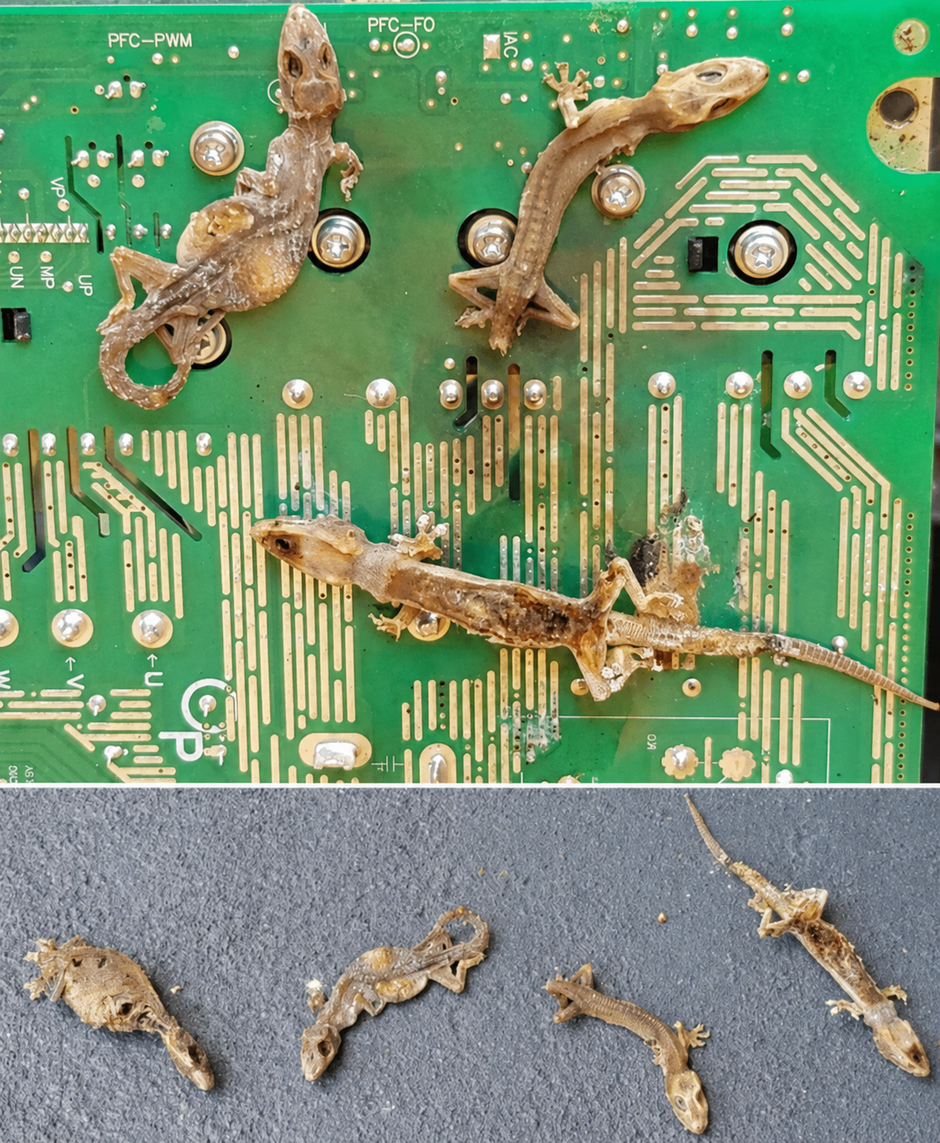
Mummified Hemidactylus frenatus found on the motherboard of an air conditioning unit on Saipan, Com-monwealth of the Northern Mariana Islands. Photo credit: respective paper in Discover Life
House geckosare familiar nighttime visitors throughout much of tropical Asia and the Pacific, often seen stalking insects on walls and ceilings near artificial lights. But Common House Geckos can have a much more costly interaction with the human environment when they find their way inside electrical equipment.
In a newly published study in Discover Life, Honorary Professor Hinrich Kaiser of the School of Biological Sciences at The University of Hong Kong (HKU) and Przemysław Zdunek report repeated incidents in which introduced Common House Geckos (Hemidactylus frenatus) entered outdoor air-conditioning units on the Pacific island of Saipan and were electrocuted after coming into contact with electronic circuitry. The encounters short-circuited the units’ motherboards and rendered the air conditioners inoperative.
The study began with what initially appeared to be an unusual isolated incident. In March 2020, an air-conditioning unit at a residence on Saipan stopped producing cool air after having remained unused for several weeks. When a technician opened the outdoor compressor, an adult gecko was found fused to its motherboard. Replacing the circuit board restored the unit to operation.
Less than three months later, the problem returned on a much larger scale. Three of four air-conditioning systems at the same residence failed simultaneously. Inspection revealed multiple dead geckos on each of the three motherboards—seven animals in total, including two egg-bearing females. Once again, replacement of the damaged circuit boards restored the units.
“What initially looked like a bizarre one-off event suddenly became something much more interesting,” Professor Kaiser said. “We had geckos repeatedly entering air conditioners, dying on the electronics, and taking expensive equipment with them. That made us wonder how widespread this interaction between animals and technology might actually be.”
Why would a gecko enter an air conditioner?
The answer may lie in the same characteristics that have made house geckos highly successful at living alongside humans throughout the tropics.
Electronic components can remain warmer than their surroundings, providing ectothermic animals such as geckos with attractive sites for thermoregulation. Enclosed electrical equipment may also offer shelter from predators and protected locations associated with reproduction. Unfortunately for a gecko, crossing electrically charged contacts on a circuit board can transform an apparently desirable refuge into a death trap.
Professor Kaiser and Zdunek therefore searched the scientific literature and other published sources for similar incidents. They identified reports from Australia, Cuba and Taiwan involving geckos damaging air conditioners, televisions, computers and other electrical equipment. Previous research in Taiwan documented repeated gecko-induced short circuits in air conditioners, while work in Cuba reported dozens of incidents involving electrical appliances.
The consequences can extend beyond an inconvenient repair bill. Geckos have also been implicated in failures involving electrical meter rooms and high-voltage switchboards, raising the possibility of electrical fires and risks to people working with affected equipment.
A small animal with potentially large economic consequences
The problem may become increasingly relevant as air conditioning and other electronic infrastructure become more widespread in regions affected by extreme heat.
“House geckos are extraordinarily successful at living alongside people,” Professor Kaiser said. “As humans install more electronic equipment in warm climates, we are also unintentionally creating more opportunities for these animals to interact with that technology.”
The authors emphasise that the problem is likely to be underreported. Technicians may replace a failed circuit board without identifying the animal responsible, while appliance owners may never learn why their equipment stopped working.
Preventing access may therefore be more effective than attempting to control the geckos themselves. The study discusses approaches including screening ventilation and drainage openings and sealing other entry points, while maintaining the airflow and drainage required by the equipment.
The observations also illustrate a broader and less recognised consequence of biological invasions. The Common House Gecko has spread widely beyond its native range through its association with human transportation and settlements. Its impacts are generally considered in ecological terms, including interactions with native species. The new study demonstrates that successful invasive species can also have unexpected consequences for human infrastructure.
“Biological invasions do not stop at the boundary between nature and technology,” Professor Kaiser said. “An animal weighing only a few grams can short-circuit an expensive piece of equipment. These interactions are easy to overlook, but multiplied across tropical cities and millions of appliances, their economic consequences could become significant.”
The paper, “Air conditioning units as death traps for introduced Common House Geckos, Hemidactylus frenatus, on Saipan, Commonwealth of the Northern Mariana Islands, with a discussion of impacts,” was published in Discover Life in August 2026.
You may also be interested in
02 Aug 2026

29 Jul 2026
30 Jun 2026

24 Jun 2026

21 Jun 2026

15 May 2026